If you work hard and still feel like money slips through your fingers, you are not alone — and it is probably not your salary’s fault. Most of the time, being broke is not about how much you earn. It is about small, quiet money mistakes that drain your paycheck a little at a time, month after month.
The good news? These mistakes are fixable. None of them require a raise or a side hustle. Here are the 10 most common ones, why they hurt, and exactly how to fix each.

1. Having No Budget at All
Why it hurts: Without a plan, your money decides for you — and it usually decides to leave. If you earn $3,200 a month and have no idea where it goes, you are almost certainly overspending in at least one category by $100 to $300 without noticing.
The fix: Pick one simple system and start today. The 50/30/20 rule is a great starting point: 50% of take-home pay for needs, 30% for wants, 20% for savings and debt. On a $3,200 paycheck, that is $1,600 for needs, $960 for wants, and $640 for savings. You don’t need an app — a notebook works fine for the first month.

2. Treating Your Credit Card Like Extra Income
Why it hurts: Every dollar you charge and don’t pay off grows at 20% to 25% interest a year. Carry a $2,000 balance at 24% APR and make only the minimum payment, and you will pay roughly $1,000 in interest and take over 7 years to clear it. The $2,000 of “free money” actually costs you $3,000.
The fix: Pay the full statement balance every month — treat the card as a debit card with rewards, not a loan. If you already carry a balance, stop using the card for new purchases and throw every spare dollar at the balance until it is gone.

3. Paying Only the Minimum on Debts
Why it hurts: Minimum payments are designed to keep you in debt, not get you out. On a $4,000 credit card balance at 22% APR with a $90 minimum payment, you will be paying for more than 6 years and hand over about $2,500 in interest. That is 60% more than you borrowed.
The fix: Pay as much as you can above the minimum. Even an extra $50 a month on that $4,000 balance cuts years off the timeline and saves hundreds in interest. List your debts smallest to largest and attack the smallest first — quick wins keep you motivated.

4. Having Zero Emergency Savings
Why it hurts: Without a cushion, every surprise becomes debt. The average car repair costs around $500 to $800, and a single emergency room visit with insurance can still run you $200 to $1,000 out of pocket. No savings means these go on a credit card, where interest makes them even bigger.
The fix: Build a $1,000 starter emergency fund before anything else. Open a separate savings account, set up a $25 weekly automatic transfer, and protect that money for true emergencies only. You will reach $1,000 in about 10 months — or faster if you sell something or skip a few subscriptions.

5. Subscription Creep
Why it hurts: Subscriptions are designed to be forgotten. The average American now spends around $200 a month on subscriptions — streaming, music, apps, boxes, gym memberships. That is $2,400 a year on things you barely think about. Cancel just two $15 subscriptions and you free up $360 a year.
The fix: Once a quarter, open your bank statement and list every recurring charge. Ask about each one: “Did I use this in the last 30 days?” If the answer is no, cancel it today — you can always rejoin later. Set a calendar reminder to do this again in three months.

6. Eating Out and Takeout on Autopilot
Why it hurts: A $12 lunch five days a week is $3,120 a year. A $30 Friday takeout habit is $1,560 a year. Food is the easiest category to overspend in because every purchase feels small — until you add them up. Many people spend $300 to $500 a month on food they don’t even remember eating.
The fix: Don’t quit restaurants entirely — that never lasts. Instead, set a number: $150 a month for dining out, for example. When it is gone, it is gone. Packing lunch just three days a week saves roughly $150 a month — that is $1,800 a year back in your pocket.

7. Lifestyle Inflation (Spending Every Raise)
Why it hurts: You get a $200-a-month raise, and suddenly you have a nicer apartment, a new car payment, and a more expensive phone plan. Two years later you earn $5,000 more a year but save exactly the same amount: nothing. Every raise you spend is a raise your future self never sees.
The fix: When your income goes up, save at least half of the increase before you touch the rest. Got a $300 monthly raise? Set up a $150 automatic transfer to savings on the same day your new pay starts. You still get to enjoy $150 more a month — and your savings quietly double.
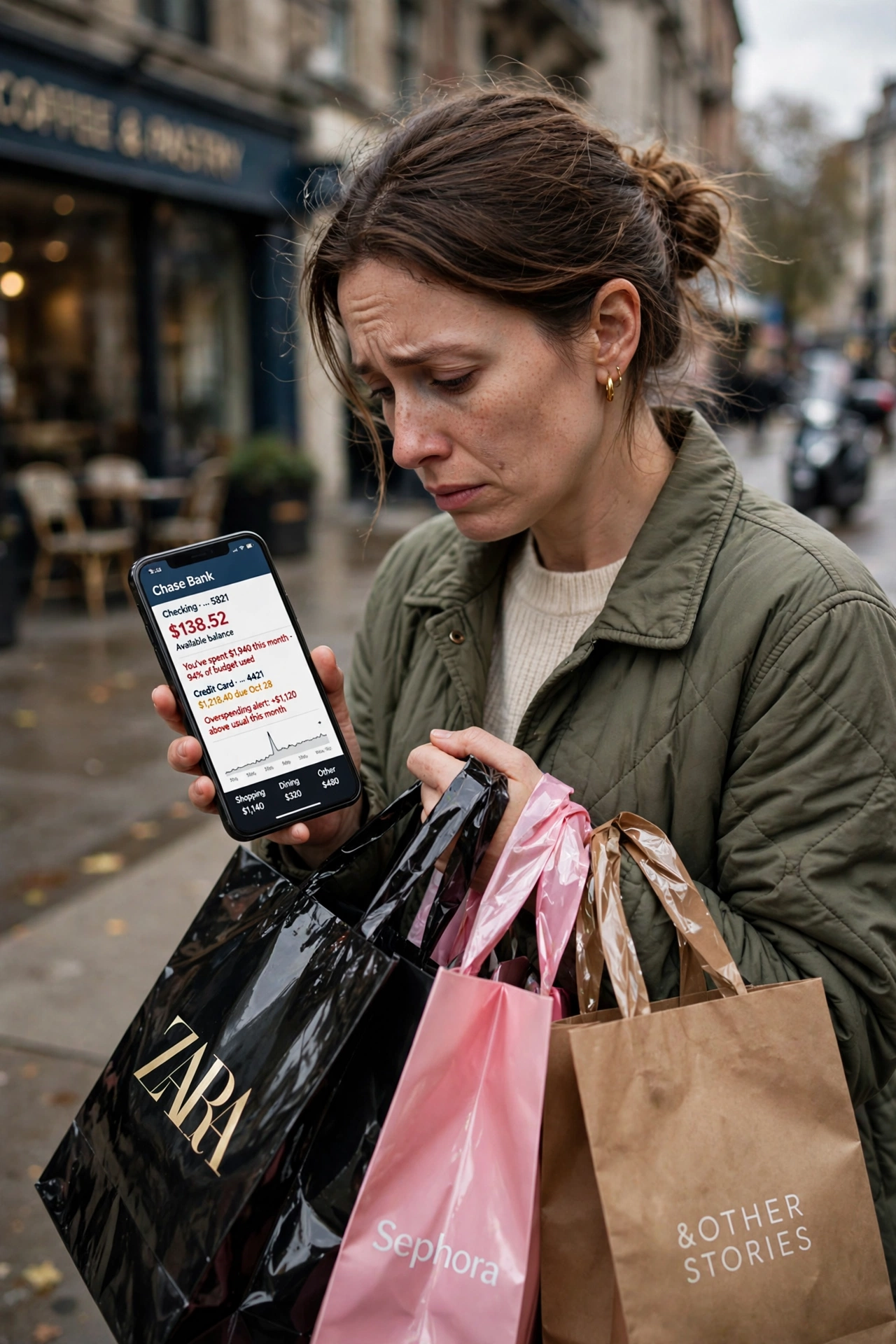
8. Not Tracking Where Your Money Goes
Why it hurts: You can’t fix what you can’t see. Most people underestimate their spending on food, shopping, and “small stuff” by 20% to 30%. That $50 you think you spend on coffee might actually be $130. The gap between what you think you spend and what you actually spend is where your savings disappear.
The fix: Track every dollar for 30 days. Use your bank’s app, a free tool, or just a notebook — the method doesn’t matter, the honesty does. At the end of the month, sort your spending into categories. You will find at least one surprise, and that surprise is your first savings opportunity.

9. Impulse Buying (The “Add to Cart” Trap)
Why it hurts: Online shopping turned impulse buying into a one-click habit. The average impulse purchase is around $30 to $60, and most people make several a month. Three $40 impulse buys a month is $1,440 a year on things you didn’t plan to buy and often barely use.
The fix: Use the 48-hour rule. When you want something that isn’t a necessity, wait two full days before buying it. Add it to a wishlist instead of your cart. Around 7 out of 10 times, you will forget about it entirely — and each time you do, that is $40 you kept. Unsubscribe from store marketing emails too, so the temptation stops showing up in your inbox.

10. Waiting to Start Saving “Until Things Settle Down”
Why it hurts: Things never settle down. There is always a reason to wait — the holidays, the car payment, the trip. Meanwhile, time is the most powerful ingredient in saving and investing. If you invest $200 a month starting at 25 and earn a rough average of 7% a year, you will have around $400,000 by 65. Start at 35 instead, and you get around $190,000. That 10-year delay costs you more than $200,000.
The fix: Start embarrassingly small, but start this week. Open a savings account or a retirement account (like a 401(k) through work or a Roth IRA) and set up an automatic $50 monthly transfer. You can increase it later. The amount matters less than the habit — and the clock is already ticking.

The Bottom Line
Being broke is usually not a math problem — it is a habits problem. Pick the two or three mistakes from this list that hit closest to home and fix just those this month. Small changes compound: cancel the subscriptions, start the automatic transfer, wait 48 hours before buying. Your future self is built by the small decisions you make this week, so start with one.