Black Friday is November 27. That’s about six weeks away, and between now and then, every store you have ever given your email address to will declare a personal emergency that can only be solved by you buying something.
Here’s the number they are counting on: the average American spends $3,381 a year on impulse purchases — roughly $282 a month on stuff nobody planned to buy (Capital One Shopping research). And 70% of those impulse buys are triggered by the same thing. Not need. Not a broken appliance. A sale.
The hangover is predictable too: roughly 60% of Black Friday shoppers later regret what they bought. The sale decides in the moment, in the heat, in the scroll — and you pay for that decision all winter.
A no-buy list flips the order. You decide now, in a calm moment, at your kitchen table, what future-you is not allowed to buy. Then when the sale shows up in a weak moment, the decision is already made. Below is a starter list of 25 things to stop buying — steal it, cross off what doesn’t fit, add what’s missing. The list only works when it’s yours.
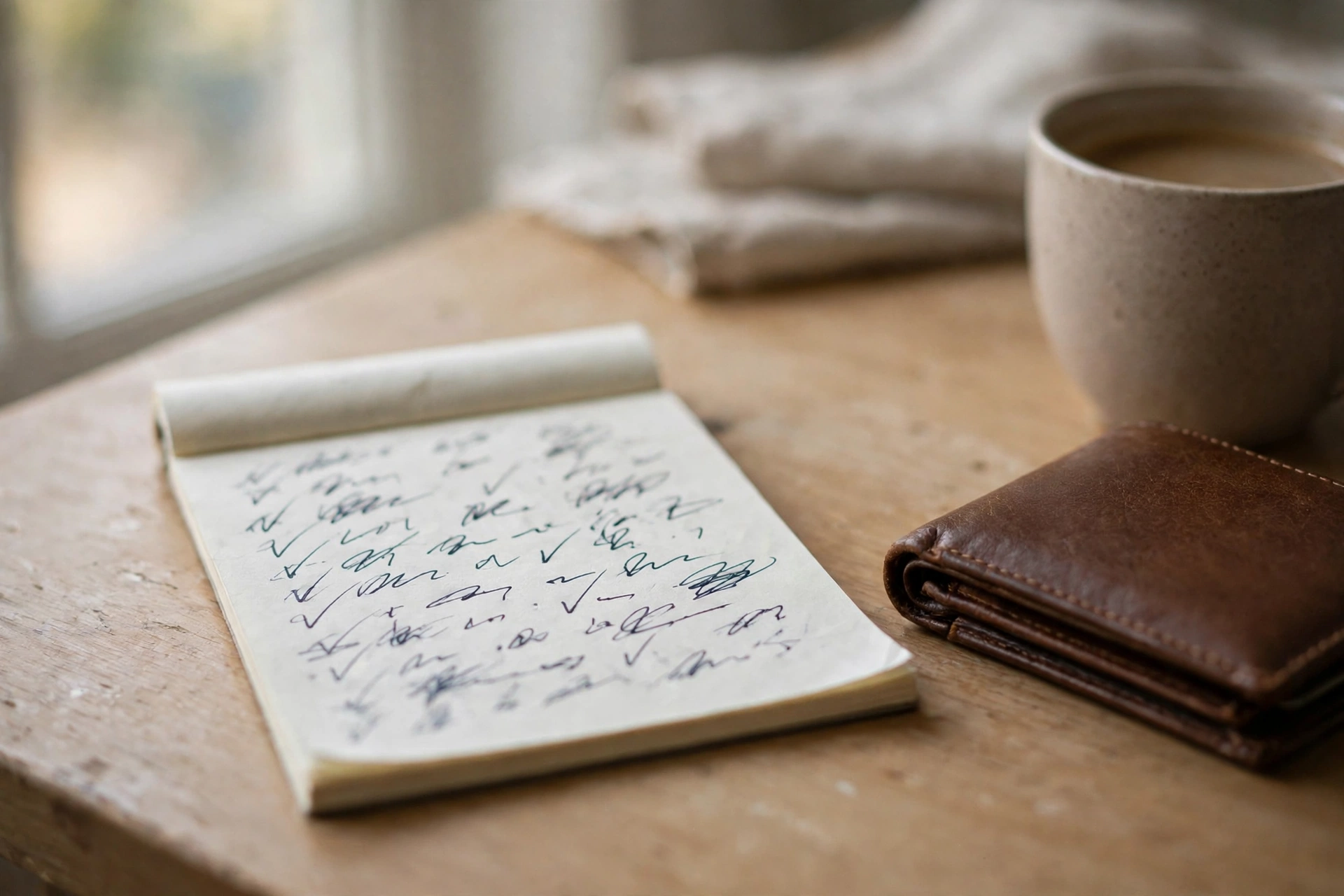
What a No-Buy List Actually Is
A no-buy list is a written list of purchase categories you are banning for a set period — say, the rest of 2026 and into a No Buy 2027 — along with your rules and your exceptions, written down in advance.
It bans categories, not spending. Rent still gets paid. Groceries still get bought. Gas, medicine, the plumber when the pipe bursts — life continues. What stops is the optional stuff that leaks out of your account $18 at a time.
This format is all over TikTok and Pinterest right now for a reason: it’s simple enough to actually do. Bustle covered the trend and reported one creator, @miawestrap, saving around $940 by following her list. Treat that as proof the format works for real people, not as a promise of your number. Your number depends on your leaks.
One honest distinction, because people mix these up: a no-buy list is not a no-spend month. A no-spend challenge is a short freeze — almost nothing non-essential gets bought for 31 days. Freezes are sprints: powerful, kind of miserable by day 20, and then over, which is when the spending roars back. A no-buy list is the opposite design. Smaller bans, your own exceptions, built to survive birthdays, holidays, sales, and bad weeks. If the freeze is a crash diet, this is just deciding what you don’t eat anymore.
How to Make a No-Buy List in 3 Columns
Grab a notebook page or a notes app. Draw three columns. This takes about fifteen minutes.
Column 1: Banned. The categories that take your money and give you nothing back. You already know most of them, but check last month’s bank statement to be sure — the purchases you’ve forgotten you made are the loudest clues. Subscriptions are the classic: Americans estimate they spend $86 a month on subscriptions, but when researchers added them up, the real figure was $219 a month (C+R Research). Your banned column basically writes itself off that statement.
Column 2: Allowed, with limits. Things you still buy, but capped. Coffee out once a week instead of daily. One new book a month. Limits beat bans for the stuff you genuinely enjoy, because a ban you resent is a ban you break.
Column 3: Exceptions, written in advance. Replacements when something you own breaks or wears out. Gifts for specific people. Experiences you’ve decided are worth it. This column is what makes the list survivable — and it has one hard rule: an exception invented during a sale is not an exception. It’s a loophole wearing a costume.

25 Things to Stop Buying in 2027
Home & Stuff
- Candles. You already own at least two half-burned ones. A new scent is a $20 mood, not a need.
- Throw pillows and blankets. The couch is full. One more isn’t decor — it’s storage with fringe.
- Mugs and water bottles. Let the cabinet decide: if a new one doesn’t fit, you’re done buying them.
- Decor for every minor holiday. A fall bin and a Christmas bin is a collection. A bin for every month is a subscription to clutter.
- Single-job kitchen gadgets. Avocado slicers, egg separators, banana hangers — a knife and your hands already do all of it.
- Storage bins bought before decluttering. Organizing things you should get rid of just hides the problem in matching plastic.
- “Dupe” products. A cheap copy of something you didn’t need at full price is still something you don’t need.
Beauty & Clothes
- Fast-fashion hauls. Five $8 tops that pill by February cost more per wear than one $40 top that lasts years.
- New skincare or makeup before the current one is empty. Finish the bottle. Your skin cannot tell the difference between day 40 of one serum and day 1 of the next.
- A second version of something you already own. Backup white sneakers, a third black jacket — duplicates are just pre-paid laundry avoidance.
- Clothes for a life you don’t live. The dress for events you never attend will hang in the closet, tags on, judging you.
- Hair tools and beauty gadgets. The wand, the crimper, the facial steamer — used twice, then living under the sink forever.
- Trend pieces built for one season. Micro-trends are engineered to embarrass you by spring. That’s not a flaw in the business model; it is the business model.
Food & Drink
- Daily coffee runs. A $6 weekday coffee habit runs about $1,560 a year. Make it a written once-a-week exception, not a daily reflex.
- Food delivery fees. The meal isn’t the markup — delivery fees, service charges, and the tip routinely add a third or more. Pickup is the same dinner for less.
- Convenience-store snacks. The most expensive food in America, bought on autopilot at the gas pump.
- The midweek “one thing” grocery trip. You go in for milk and walk out with $60 of maybes. One list, one trip, once a week.
- Meal-kit boxes. Pre-portioned ingredients at near-restaurant prices. A grocery list does the same job for about half the money.
- Bottled drinks bought out of habit. Cases of water and soda when there’s a fridge and a filter at home — you’re paying for packaging, not thirst.
Digital & Entertainment
- Subscriptions you forgot you have. 42% of adults are paying for at least one subscription they forgot about (C+R Research). Cancel first; you will not miss them.
- In-app purchases and game currency. Designed to not feel like money. It is money — it just left through a smaller door.
- A new streaming service for one show. Rotate instead: one service at a time, cancel when the show ends, put the next one on the want list.
- Online courses you’ll start “someday.” Finish one you already own before buying another. Unstarted courses are just expensive intentions.
- Phone cases and tech accessories in every color. The phone is protected or it isn’t. A fourth case protects nothing but the store’s margin.
- Anything you weren’t shopping for until a sale showed it to you. Remember the 70% stat: if the deal found you, it wasn’t a deal. It was bait.
The 5 No-Buy Rules That Make It Stick
A list alone won’t survive Black Friday. These rules are the enforcement system.
Rule 1: Keep a 30-day want list. Everything you crave goes on a dated list in your notes app instead of in a cart. Still want it in 30 days, and it fits the budget? Now it’s a planned purchase. Most wants are dead by day three — the list doesn’t say no, it says “prove it.”
Rule 2: One in, one out. New shoes means the old pair gets donated or sold the same week. This single rule quietly kills duplicates, upgrades, and “backup” purchases.
Rule 3: Unsubscribe and unfollow the triggers. Promo emails, brand accounts, sale alerts, shopping apps sitting on your home screen — delete, unfollow, unsave your card details. Willpower loses to a push notification at 9 p.m. every single time. Remove the notification and you don’t need the willpower.
Rule 4: Exceptions are written before, never during. You can revise your list at a calm review. You cannot revise it standing in a checkout line with a countdown timer on the screen. Adding an exception mid-sale is just buying with extra paperwork.
Rule 5: Do a 10-minute monthly review. Same day each month: what did you almost buy, what slipped through, which rule needs adjusting? Lists that never get reviewed get quietly abandoned. And say the list out loud — tell a friend, a partner, the group chat. That’s the loud budgeting idea, and it works because secrets are exactly where impulse buys live.
What to Do When You Slip
You will slip. That’s not pessimism, it’s the data: 81% of people had already made an impulse purchase in 2026 even though most said their budgets were tighter than last year, and 62% feel regret over impulse buys at least some of the time (PartnerCentric survey, via USA TODAY).
So when it happens: log it. Write down what you bought and, more usefully, what triggered it — the sale email, the bad day, the midnight scroll. Then fix the trigger: unsubscribe it, unfollow it, add it to the banned column. No guilt spiral, no “well, the month is ruined” collapse. The list survives a slip because it was never a streak to break.
And if the thing is still returnable, return it. The walk back into the store is annoying on purpose. That annoyance is the lesson sticking.
FAQ
What’s the difference between a no-buy list and a no-spend month?
A no-spend month freezes nearly all optional spending for about 31 days — intense and temporary. A no-buy list bans specific categories you choose, with written exceptions, for as long as you keep it — gentler, and built to last a year instead of a month.
How many things should be on my no-buy list?
Start with three to five categories pulled from your own bank statement, then borrow from the 25 above. A list of 40 bans collapses by February. Five honest ones hold.
Can I do a no-buy quarter instead of a full year?
Yes — and the last quarter of the year is the highest-value one to pick, because it’s when the sales are loudest. Run October through December, review monthly, and renew in January if it’s working. Plenty of people start exactly there before committing to a No Buy 2027.
What do I do with the money I don’t spend?
Give it a job the same day, or it drifts back into spending. When you skip a purchase, move that amount somewhere with a name on it — debt payoff, an emergency fund, or a sinking fund for a goal you’d otherwise end up financing. Unassigned savings don’t stay saved.
Here’s the truth nobody selling you something wants to say out loud: a no-buy list isn’t punishment. It’s deciding in a calm moment so a sale can’t decide for you in a weak one. Write yours this week — fifteen minutes, three columns — and let Black Friday do its worst on November 27. Your list gets there first.
Pingback: The 30-Day Rule: The Simple Waiting List That Stops Impulse Buying and Saves $282 a Month - Luxiro